
Star Citizen Performance Guide
No more guessing: official specs, practical build tiers, and the exact settings that give you the biggest FPS wins.
Requirements: min / recommended / optimal
New to the terms? Beginner glossary.
Star Citizen is a streaming-heavy game. If one pillar is weak, you’ll feel it even with a strong GPU: SSD (asset streaming), RAM + pagefile headroom (stutter/crash prevention), and CPU headroom (cities + big fights).
- Official = RSI support docs
- Rule-of-thumb = practical targets that consistently feel good for most players
| Tier | CPU | GPU | RAM | Storage | Who it’s for |
|---|---|---|---|---|---|
| Minimum (Official) | Intel i7 (Haswell+) / AMD Excavator+ | DX11.1 GPU, 4 GB VRAM (example: GTX 1060) | 16 GB | 150+ GB SSD required | It runs. Expect stutter in cities + heavy scenes. |
| Recommended (Official) | Intel i7 (Haswell+) / AMD Ryzen 5+ | DX12 GPU, 8 GB VRAM | 32 GB DDR4 | 150+ GB SSD required | Good beginner baseline. Fewer spikes, fewer crashes. |
| Optimal (Rule-of-thumb) | Strong modern 8-core-class CPU | 12–16 GB VRAM for high settings / 1440p+ | 32–64 GB | NVMe SSD + 20% free space | Best “feels good” setup for cities + big events. |
Example PC builds (Rule-of-thumb)
Pick the tier that matches your monitor resolution. This is about stability first, then visuals.
| Tier | Target | CPU examples | GPU examples | RAM | Notes |
|---|---|---|---|---|---|
| Budget (1080p) | Playable + stable baseline | Ryzen 5 5600 / i5-12400F+ | RTX 3060 12GB / RX 6700 XT | 32 GB | Use upscaling + Low clouds in cities. |
| Balanced (1440p) | Best value “smooth” | Ryzen 5 7600 / i5-13400+ | RTX 4070 / RX 7800 XT | 32–64 GB | Great all-rounder for events and daily play. |
| High-end (1440p/4K) | Best “feels good” | Ryzen 7 7800X3D / Ryzen 7 5800X3D | RTX 4070 Ti Super / RTX 4080 / RX 7900 XT | 64 GB | City consistency improves most from CPU + RAM headroom. |
2-minute readiness check (concrete thresholds)
This is the fastest way to predict your experience. If you fail one item, fix that first.
| Step | Check (what you need) | What it tells you |
|---|---|---|
| 1 | Game is on SSD/NVMe (not HDD) | SSD is the baseline for streaming. HDD = constant hitching. |
| 2 | Free SSD space: ideally 20% free (minimum: 30+ GB) | Low space worsens caching and can break pagefile headroom. |
| 3 | RAM: 16 GB minimum, 32 GB recommended | 16 GB often relies on pagefile (more stutter/crash risk). |
| 4 | VRAM: 4 GB minimum, 8 GB+ recommended | VRAM overrun causes big FPS drops and hitching. |
| 5 | Baseline test: stable driver, overlays OFF | Removes avoidable variables while you measure the baseline. |
- Move Star Citizen to SSD/NVMe if it isn’t already.
- Close overlays for your first test (Discord overlay, GeForce/AMD overlay, capture tools).
- Pagefile: set to Windows-managed (recommended by RSI). If you’re on 16 GB RAM, consider a safe custom size. (Official pagefile guide)
- Retest in the same spot before/after (same city + same direction) to compare fairly.
If you’re testing during Free Fly
Free Fly servers can be overloaded. Judge your system by stability (crashes + stutter), not perfect city FPS.
If you plan to buy
Once you pass the baseline, the next step is picking a beginner-friendly starter pack.
See starter packsBest settings for performance (beginner-safe baseline)
Goal: stable frame-times before you chase “max FPS”. Apply the baseline, then change one lever at a time.
- Upscaling (DLSS / CIG-TSR) + choose a mode
- Volumetric Clouds (biggest “city killer” for many PCs)
- Shadows (high cost + affects frame pacing)
| Setting | Recommended value | Impact | Trade-off |
|---|---|---|---|
| Graphics Renderer (Official) | Try Vulkan first. If unstable, switch back to DirectX. | High | Vulkan can be driver sensitive. |
| Upscaling Technique (Official) | DLSS (NVIDIA) / otherwise CIG-TSR | High | Lower modes look softer. |
| Upscaling Quality | Quality for 1080p/1440p, Balanced if GPU-bound | High | Balanced/Performance can look blurrier. |
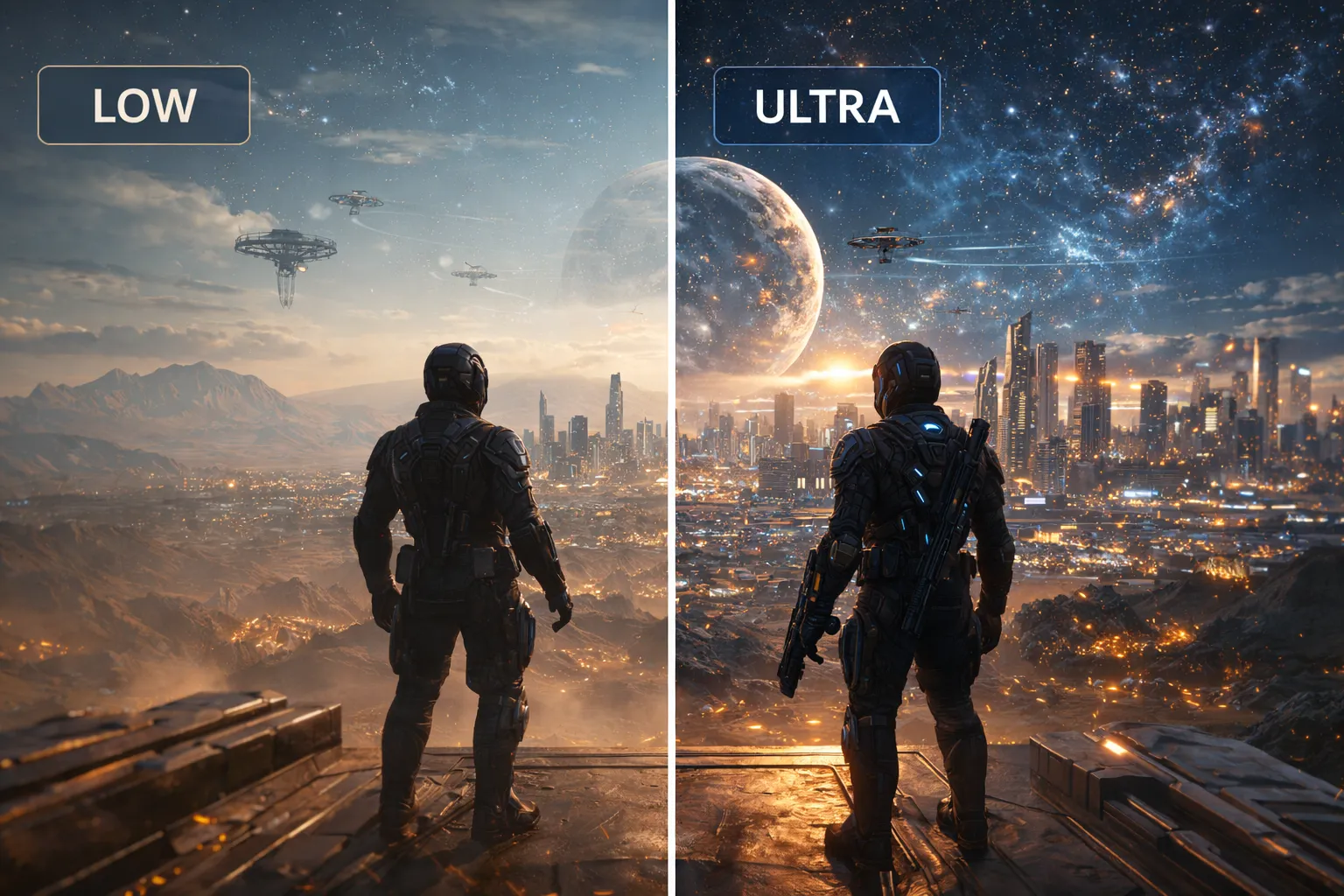
| Volumetric Clouds | Low (or Off if you need a big boost) | High | Sky/atmosphere looks flatter. |
| Shadow Quality | Medium (drop to Low in cities if needed) | High | Less detailed shadows. |
| Textures Quality | High if you have 8–12GB VRAM; Medium if VRAM is tight | Medium | Lower textures can look muddy. |
| Motion Blur / Film Grain / Chromatic Aberration | Off | Low | Purely preference (clarity vs style). |
| V-Sync | Off while troubleshooting | Medium | Possible tearing; V-Sync can add latency. |
| FPS Cap | Cap at 60 / 75 / 90 if you get wild swings | Medium | Lowers peaks, improves consistency. |
Fix stutter & low FPS (in the safest order)
Stutter usually comes from streaming + memory pressure + background hooks. Fix it in this order.
| Order | Do this | Why it works | Verify |
|---|---|---|---|
| 1 | SSD/NVMe + free space (aim 20% free) | Streaming stutter is the #1 beginner pain point. | Retest the same city route; hitching should reduce. |
| 2 | Pagefile: Windows-managed (Official) | Prevents out-of-memory spikes/crashes when RAM is tight. | Fewer hard freezes + fewer sudden FPS collapses. |
| 3 | Disable overlays while testing (Discord / NVIDIA / AMD) | Overlays hook rendering and can spike frame-time. | Compare frame pacing in the same spot. |
| 4 | Repeat the same route 2–3 times before judging | Streaming + shader caching can look worse on the first run. | Later runs should feel smoother in the same route. |
CPU-bound or GPU-bound? Use this 60-second test
Don’t guess. This tells you what to change — and what to ignore.
- Stand still in a demanding spot (city hub is fine).
- Lower Resolution (or switch Upscaling to a stronger mode) and set Volumetric Clouds to Low.
- If FPS rises ~15%+, you’re likely GPU-bound. If FPS barely changes, you’re likely CPU/streaming-bound.
Likely GPU-bound
- Lowering resolution / stronger upscaling increases FPS a lot.
- Clouds and shadows have a big FPS impact.
- Performance is worse in atmospheres or with lots of effects.
Likely CPU / streaming-bound
- Lowering resolution barely changes FPS.
- Stutter spikes happen while moving/loading assets.
- Cities feel inconsistent even on low settings.
Crash fixes (common causes)
Use this order. It solves most crashes without guesswork.
| Step | Action | Why it helps |
|---|---|---|
| 1 | Verify game files in the launcher | Fixes corrupted/partial downloads and missing assets. |
| 2 | Disable overlays and capture tools | Removes a frequent crash source while troubleshooting. |
| 3 | Remove unstable overclocks / undervolts | Star Citizen can be sensitive to borderline stability. |
| 4 | Update to a stable GPU driver | Eliminates driver-level instability and rendering errors. |
| 5 | Check pagefile settings (Windows-managed is safest) | Out-of-memory conditions are a common crash trigger, especially on 16 GB. |
Free start bonus (only during signup)
If you’re creating a brand-new account, a referral code gives you +50,000 UEC to start with. It’s optional — but if you plan to buy anyway, it’s the easiest free boost you’ll ever get.
Upgrades that matter (highest ROI first)
Want the biggest improvement per euro? Prioritize stability first (stutter/crashes), then chase resolution/visuals.
| Upgrade | Impact | When it’s worth it |
|---|---|---|
| SSD / NVMe | High | If the game is on HDD or a slow drive. |
| RAM headroom | High | If you’re on 16 GB, upgrade to 32 GB. If you multitask/stream, consider 64 GB. |
| CPU headroom | Medium | If lowering resolution barely helps and hubs feel choppy/uneven. |
| GPU | Medium | If you’re clearly GPU-bound and want higher resolution or sharper visuals. |